
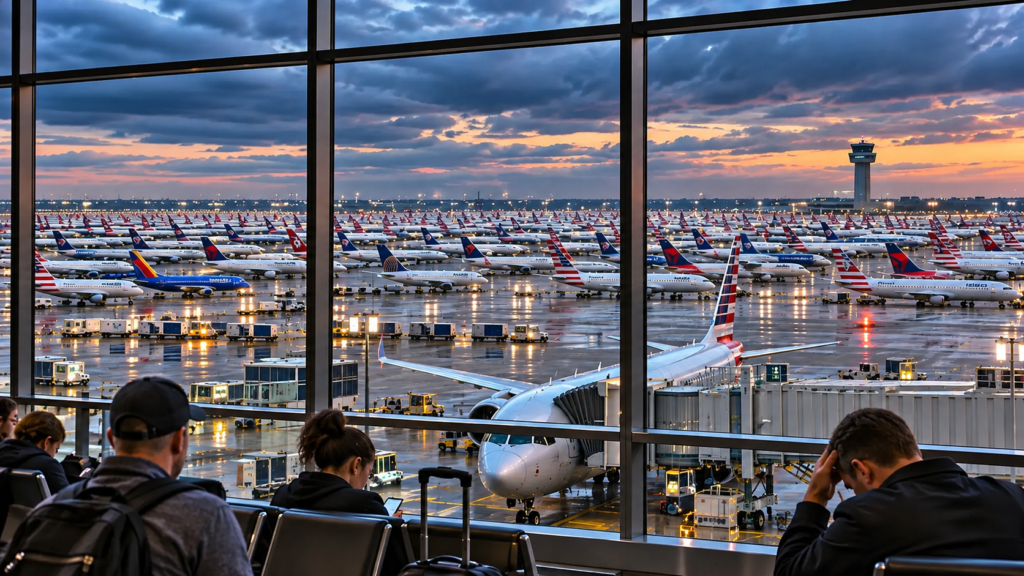
The Federal Aviation Administration (FAA) ordered a nationwide ground stop on November 13, 2026, after a major telecommunications failure disrupted air traffic control communications across the United States. The emergency order halted departing flights at airports nationwide, causing thousands of cancellations and delays while leaving travelers stranded. Transportation Secretary Sean Duffy confirmed that communication problems affected all Air Route Traffic Control Centers, prompting federal aviation officials to suspend departures for safety reasons. Aircraft already airborne were permitted to land, while certain international flights received exemptions.
FAA COMMUNICATION FAILURE DISRUPTS U.S. AVIATION
The nationwide shutdown represents one of the most significant disruptions to American aviation in recent history, following similar emergency ground stops during the September 11, 2001, terrorist attacks and a major FAA computer system failure in January 2023. Flight-tracking data indicated approximately 11,000 flights had been delayed or canceled as the disruption spread across major airports. Federal technicians launched an investigation into the communications failure, while the Department of Homeland Security stated that investigators had found no indication of a deliberate cyberattack. The incident raised serious concerns about aging aviation infrastructure, telecommunications reliability, and the resilience of critical transportation systems.
NATIONWIDE GROUND STOP FOLLOWS MICROSOFT GLOBAL OUTAGE
The aviation emergency occurred just one day after Microsoft experienced a widespread service outage on November 12, disrupting Outlook, Exchange Online, and several Microsoft 365 applications used by businesses worldwide. Microsoft attributed its service disruption to overloaded server processes responsible for establishing secure connections, preventing systems from processing requests. Although the timing of the two incidents raised questions about potential connections between critical technology failures, federal officials stated that the FAA communications outage was unrelated to Microsoft’s disruption. Microsoft also reported no indication that its outage resulted from malicious cyber activity.
CRITICAL INFRASTRUCTURE FAILURES HIGHLIGHT CYBERSECURITY RISKS
The back-to-back disruptions demonstrate how telecommunications failures, cloud service outages, and aging digital infrastructure can interrupt essential operations on a national scale without requiring a confirmed cyberattack. Aviation authorities and enterprise security teams face growing pressure to strengthen network redundancy, disaster recovery procedures, infrastructure monitoring, and incident response capabilities. Organizations responsible for critical infrastructure should evaluate communication dependencies, establish alternative operational systems, and regularly test business continuity plans. As federal investigators work to determine the precise cause of the FAA outage, the incident reinforces the importance of protecting interconnected technology systems against both malicious threats and unexpected technical failures.