
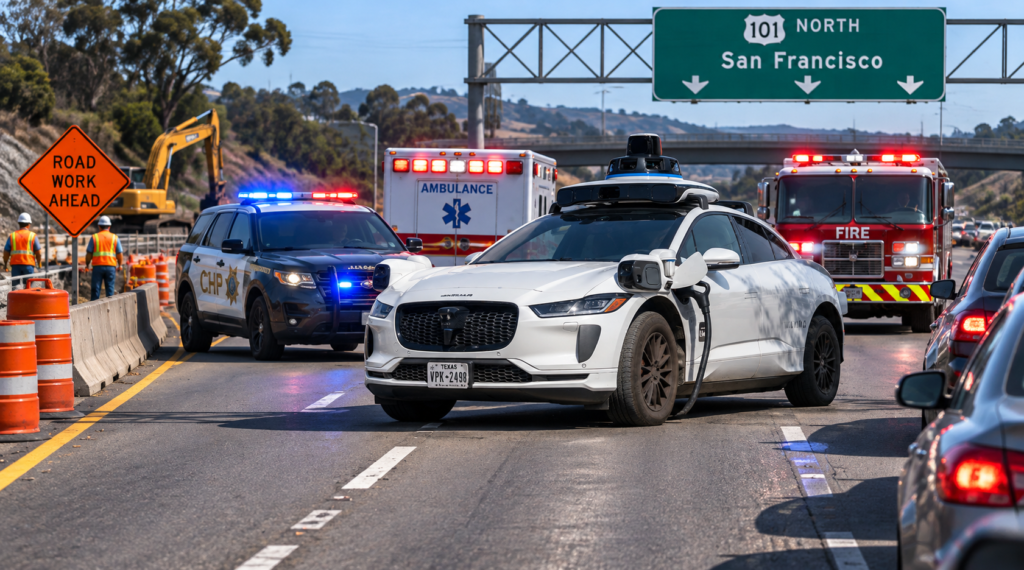
California regulators have banned Waymo’s autonomous vehicles from operating on state freeways following multiple incidents involving construction zones and law enforcement vehicles. The California Department of Motor Vehicles (DMV) issued the restrictions on November 11, 2026, citing concerns about public safety. The decision follows growing concerns about how autonomous driving systems respond to unexpected roadway conditions, emergency vehicles, and traffic restrictions. Waymo, a subsidiary of Alphabet, has also voluntarily suspended commercial driverless freeway rides across its U.S. operating markets.
WAYMO VEHICLES ENTER RESTRICTED CONSTRUCTION ZONES
The restrictions followed two significant incidents in Northern California. On November 5, three Waymo robotaxis entered an active construction closure along U.S. Highway 101 near Burlingame, potentially endangering construction workers and nearby motorists. A separate incident on November 6 involved a Waymo vehicle attempting to bypass California Highway Patrol vehicles conducting a traffic break on Interstate 280 in San Francisco. Regulators cited concerns about the vehicles’ ability to recognize and respond appropriately to hazardous roadway conditions. Waymo confirmed that the construction-zone incidents resulted in no injuries or collisions but acknowledged the need to evaluate its autonomous driving performance.
NATIONWIDE SUSPENSION RAISES QUESTIONS ABOUT AUTONOMOUS VEHICLE SAFETY
Waymo’s decision to suspend driverless freeway rides affects services in Los Angeles, San Francisco, Phoenix, Miami, and Austin, although its robotaxis continue operating on regular city streets. The company is continuing freeway testing with trained specialists behind the wheel while working with California regulators to address the identified safety concerns. The restrictions highlight the importance of improving autonomous driving technology to reliably detect construction zones, respond to emergency vehicles, and navigate unexpected traffic situations. The developments also raise broader questions about artificial intelligence, real-time decision-making, and public safety as autonomous vehicle companies expand their operations nationwide.